
AI Discovers New Physics in Dusty Plasma: Emory Researchers Unveil New Laws Beyond the Black Box
Emory University physicists used physics-aware AI to discover non-reciprocal force laws in dusty plasma with over 99 percent accuracy.
Unmasking the Invisible Forces of the Fourth State of Matter
Emory University physicists have successfully utilized a custom-designed, physics-aware neural network to uncover entirely new laws of nature within dusty plasma, a complex state of matter often found in planetary rings and interstellar clouds. The research, led by senior co-authors Justin Burton and Ilya Nemenman, represents a significant departure from traditional AI applications that merely analyze data or predict outcomes. Instead, the team has demonstrated that artificial intelligence can actively formulate fundamental physical laws that have previously eluded human intuition and classical computational models.
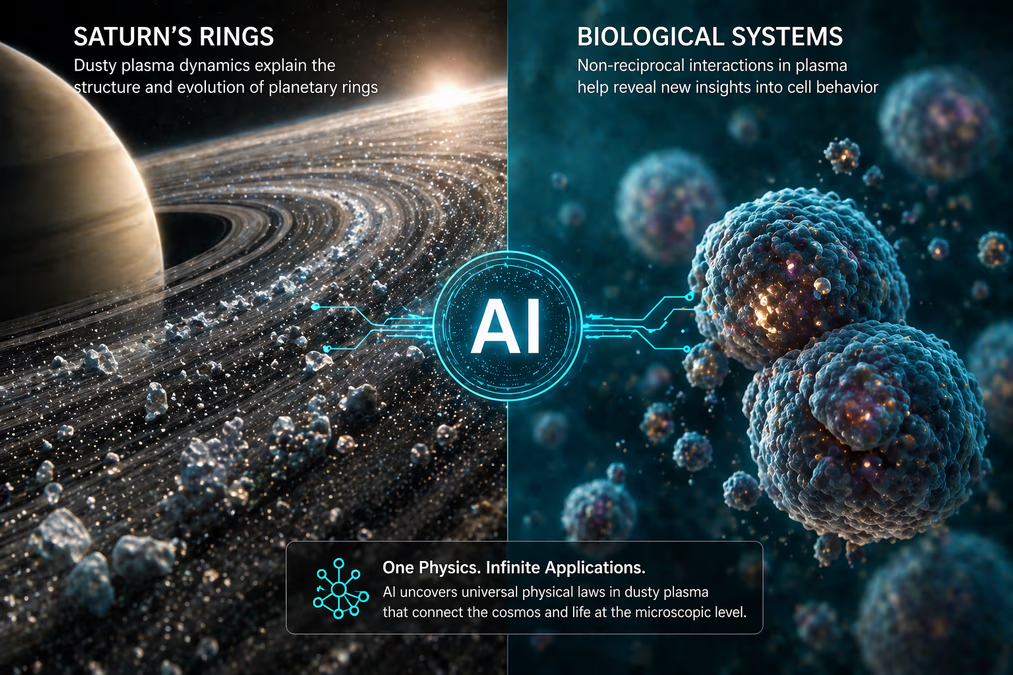
Dusty plasma is frequently referred to as the "fourth state of matter." It consists of an ionized gas filled with interacting charged dust particles. These systems are ubiquitous throughout the universe—appearing in the rings of Saturn and on the lunar surface—but they also manifest on Earth in more grounded contexts, such as the soot particles in wildfires that can disrupt local communications. Despite their prevalence, modeling the intricate interactions between these particles has historically been a monumental challenge for the scientific community.
Beyond the Black Box: Physics-Aware AI
The methodology employed by the Emory team involved a sophisticated combination of precise 3D tracking and a neural network built with inherent physical constraints and symmetries. This "physics-aware" approach ensures that the AI’s outputs remain physically plausible and, crucially, interpretable by human researchers. By tracking individual particles in a tomographic imaging setup, the team provided high-resolution data that allowed the AI to identify patterns hidden within the chaotic motion of the plasma.
Professor Justin Burton, a senior co-author on the study, emphasized that this method moves past the limitations of traditional machine learning. He noted that they showed it is possible to use AI to discover new physics. Burton further clarified that the method is not a black box; the team understands how and why it works, and the framework it provides is universal. According to Burton, it could potentially be applied to other many-body systems to open new routes to discovery.
Challenging Long-Held Theoretical Assumptions
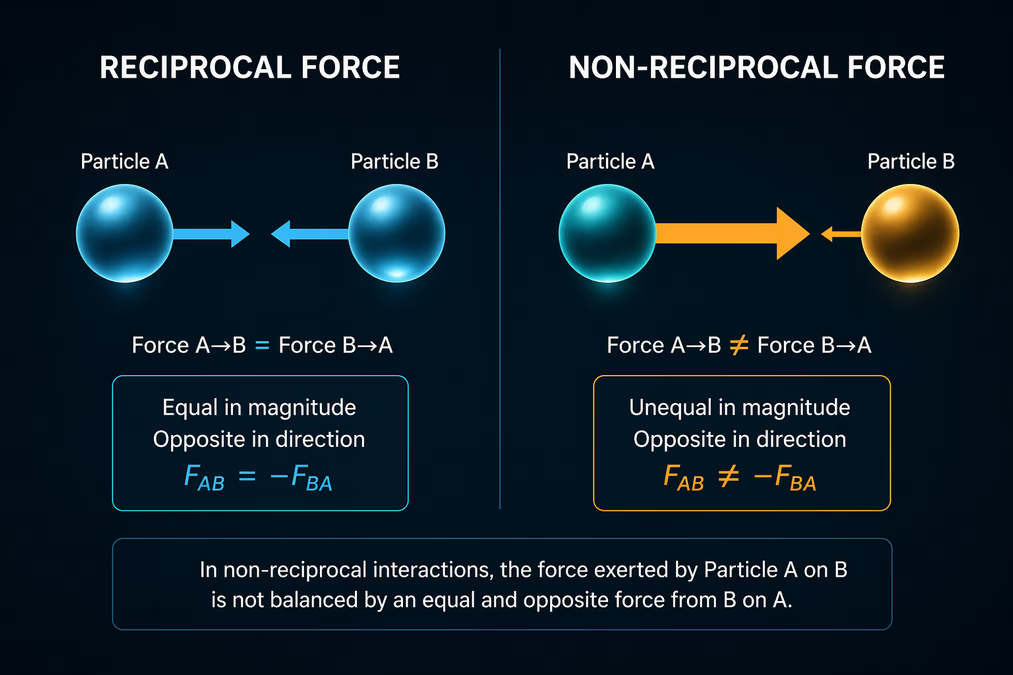
The most striking discovery made by the AI was the identification of complex, non-reciprocal forces. In a typical physical interaction, such as two billiard balls colliding, the force exerted by one is mirrored by the other. However, in dusty plasmas, particles can influence one another differently—one particle might push a neighbor away while the neighbor does not push back with equal force. This one-way interaction has been notoriously difficult to measure accurately until now.
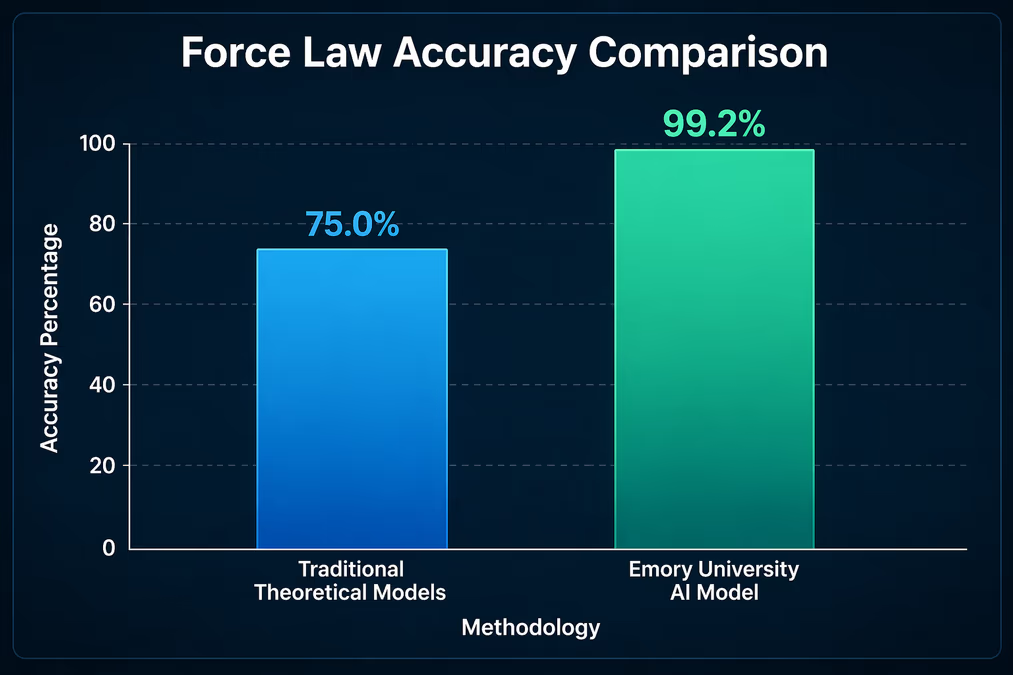
The AI model captured these non-reciprocal forces with an accuracy exceeding 99%. This precision allowed the researchers to identify flaws in existing scientific frameworks. Ilya Nemenman, Professor of Theoretical Physics at Emory, explained that they can describe these forces with an accuracy of more than 99%. Nemenman added that it is even more interesting that they showed some common theoretical assumptions about these forces are not quite accurate. He stated that the team is now able to correct these inaccuracies because they can see what is occurring in such exquisite detail.
The findings, published in the Proceedings of the National Academy of Sciences (PNAS), revealed that previous assumptions regarding how particle charge relates to size in dusty plasmas were oversimplified. By seeing through the noise of the data, the AI formulated a more accurate representation of the underlying reality.
Implications for Science and Material Engineering
This breakthrough signals a profound shift in the role of artificial intelligence within the laboratory. By moving from a tool for prediction to a tool for discovery, AI is becoming a digital collaborator capable of refining and improving human-made theories. The interpretability of the Emory model is key to this transition, as it allows scientists to trust and verify the machine's findings.
The potential applications for this universal framework extend far beyond plasma physics. Many-body systems—those composed of numerous interacting parts—are found across various disciplines. In materials science, this AI could be used to understand the behavior of colloids, such as paint or ink. In biology, it could help researchers model the clusters of cells in living organisms, where non-reciprocal interactions often govern how tissues form and grow.
As the methodology is adapted to other complex systems, it promises to accelerate the pace of scientific understanding. By leveraging AI to handle the staggering complexity of many-body interactions, researchers are gaining a new lens through which to view the fundamental rules of the universe, turning previously "invisible" forces into quantifiable laws.